Friendship as a Social Responsibility, Not a Choice
Rooted in an ancient Telugu verse attributed to Bhartruhari, the essay defines true friendship as a set of six virtues centered on guidance, protection, loyalty, and moral support. It argues that friendship is not merely to be found but consciously practiced, shifting from a personal expectation to a social responsibility. In a transactional modern world, true friendship becomes a foundational ethical force essential for trust, resilience, and the moral stability of society.
Giriprakash Chodisetti
5/21/20263 min read
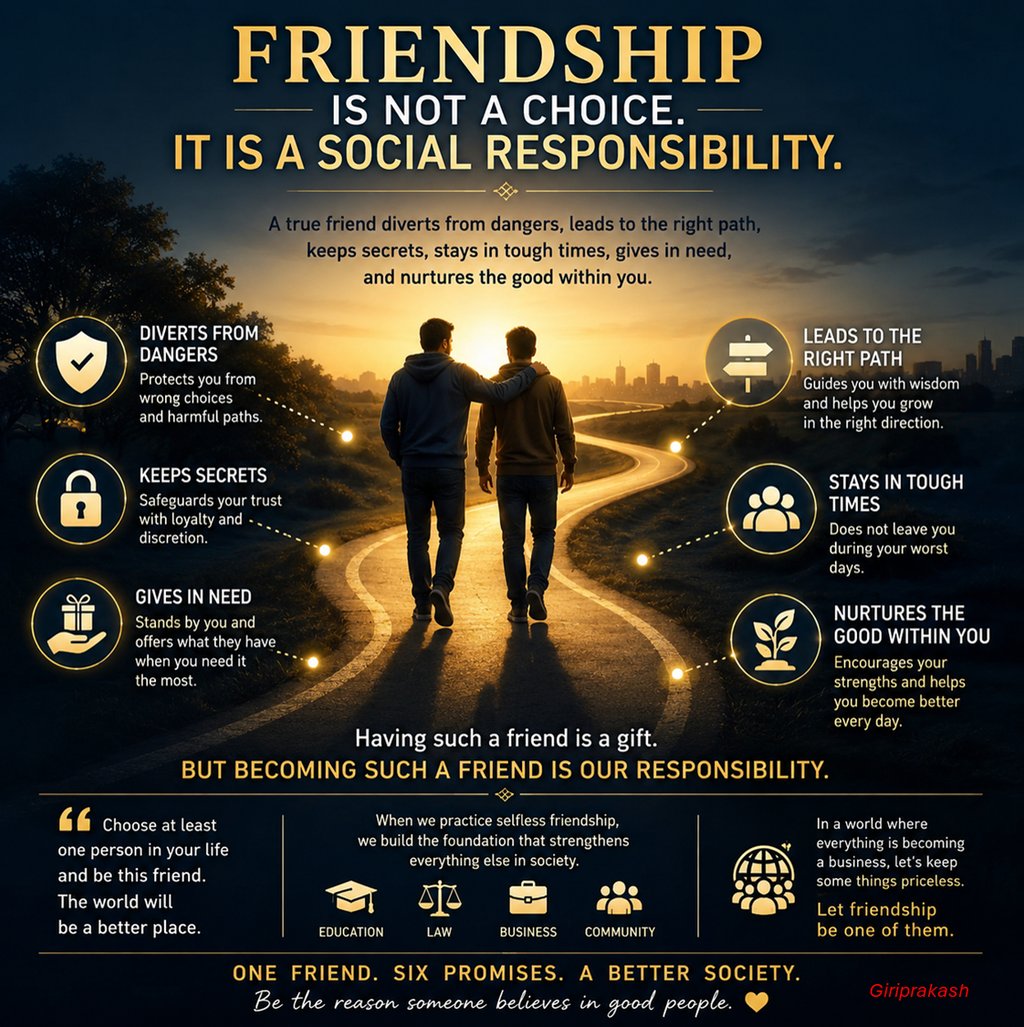
In an ancient Telugu verse attributed to Bhartruhari, a profound definition of true friendship is offered—one that transcends time, culture, and circumstance. According to this wisdom, a real friend is not merely a companion of convenience but a pillar of strength and virtue. Such a friend possesses six essential qualities: 1. They divert us from danger, 2. Guide us toward the right path, 3. Protect our secrets, 4. Stand by us during adversity, 5. Offer what they can in times of need, and 6. Nurture the good within us.
At first glance, having such a friend may seem like a rare blessing—something to be grateful for if it happens to us. However, the deeper essence of this teaching is far more transformative: it is not enough to seek such a friend; one must strive to become one. This is not a personal luxury—it is a societal necessity.
The Shift from Value to Transaction
Modern society has increasingly shifted toward a transactional model of existence. Relationships are often evaluated based on utility, return on investment, or personal gain. Even human interactions are subtly influenced by expectations of reciprocity. In such an environment, the idea of giving without expecting anything in return is slowly fading.
Yet, this is precisely where the concept of true friendship becomes revolutionary.
Friendship, in its purest form, is one of the few remaining spaces where:
Guidance is offered without control
Support is given without conditions
Trust is maintained without surveillance
If even this space becomes transactional, society risks losing its moral foundation.
Why Friendship is a Social Responsibility
A healthy society is not built solely on laws, institutions, or economic systems. It is built on invisible ethical threads that bind individuals together. Among these, genuine friendship plays a crucial role.
Consider this:
If every individual consciously chooses at least one person in their life and commits to practicing these six qualities of true friendship, the impact would be profound:
Fewer people would fall into destructive paths
Emotional resilience would increase
Trust would be restored in human relationships
Ethical behavior would naturally strengthen
In essence, friendship becomes a decentralized social support system—one that no government or institution can replicate.
The Role of “Free” in a Commercial World
Today, almost everything has a price—education, healthcare, attention, even time. While markets and businesses are essential, they function best when grounded in a society that still preserves certain values as priceless.
True friendship represents one such value.
Offering guidance, loyalty, protection, and kindness free of cost is not a loss—it is an investment into the ethical fabric of society. When individuals experience such unconditional support, they are more likely to:
Act with integrity
Build fair businesses
Contribute positively to communities
Thus, what is given freely at a personal level returns as collective societal strength.
Not Optional, But Foundational
We often treat kindness, loyalty, and moral responsibility as optional virtues—admirable, but not necessary. This mindset must change.
Just as:
Laws are necessary for order
Education is necessary for growth
Economy is necessary for survival
👉 True friendship is necessary for humanity itself to function meaningfully.
Without it, society may still operate—but it will lack trust, compassion, and long-term stability.
A Call to Action
The message is simple yet powerful:
Do not wait to find a true friend.
Choose to become one.
Identify at least one person in your life and:
Guide them when they are lost
Stand by them when they struggle
Protect their trust
Support them when they are in need
Encourage their growth
If each individual embraces this responsibility, we will not merely improve personal relationships—we will rebuild the moral architecture of society.
Conclusion
In a world increasingly driven by transactions, becoming a true friend is an act of quiet rebellion—and profound responsibility. It is a commitment to preserve what is human in humanity.
Because in the end,
a strong society is not built only by systems and structures, but by individuals who choose to stand for each other—without expecting anything in return.